
Mobile air conditioning explained: choosing the right technology for temporary cooling
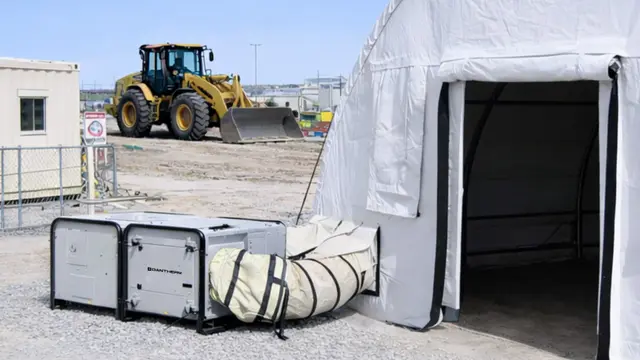
Temporary and mobile air conditioning is typically required when permanent HVAC systems are not available, not sufficient, or not economically viable. Common scenarios include commercial construction projects, industrial shutdowns, temporary buildings, events, emergency response and refurbishment works.
Selecting the correct mobile air conditioning technology is a technical decision based on:
- Required cooling capacity (kW)
- Available installation space
- Ambient operating temperature
- Air exchange requirements
- Control and monitoring needs
- Power supply constraints
At Dantherm Group, two distinct mobile air conditioning technologies are used:
- The ducted outdoor unit concept (AC-R range)
- The split system with indoor and outdoor unit (AC 7000)
This article explains how each technology works and when each is technically appropriate.
Fundamentals of temporary air conditioning
All air conditioning systems operate on the vapour compression refrigeration cycle. Heat is absorbed from the conditioned space by an evaporator, transferred via refrigerant to a condenser, and rejected to the outside environment.
In temporary systems, the main engineering differences relate to:
- How cooled air is delivered to the room
- How heat is rejected to ambient air
- How the indoor and outdoor components are arranged
- How control and regulation are implemented
These differences directly affect installation requirements and operational flexibility.
Ducted outdoor air conditioning units: AC-R technology
The Dantherm AC-R6000, Dantherm AC-R11000 and Dantherm AC-R18000 are self-contained outdoor air conditioning units. They are installed outside the structure and connected to the interior via insulated air ducts.
How AC-R units work
- The complete refrigeration system is housed in a single outdoor unit.
- Conditioned air is supplied into the building via large-diameter flexible ducts.
- Return air is extracted via one or more ducts.
- Temperature control is managed via a mechanical room thermostat (accessory).
- Two manually adjustable dampers allow fresh air mixing when required.
No indoor unit is required. Inside the building, only duct penetrations and a thermostat are needed.
When to use AC-R technology
AC-R units are technically appropriate in the following scenarios:
1. Limited indoor floor space
If there is no space available for an indoor unit, AC-R units are suitable because the entire system remains outside.
2. Harsh and changing conditions
AC-R units are extremely robust so they can endure usage in very harsh environments as well as frequent deployment changes. No frills technology speeds up deployment work and makes daily use easy while also minimizing failure potential.
3. High ambient temperature operation
AC-R units can operate in very high ambient temperatures (model dependent). This makes them suitable for hot climate deployment and demanding environments.
4. Requirement for fresh air exchange
AC-R units allow controlled intake of outside air via adjustable dampers. This is useful where ventilation or air renewal is required.
5. Combined cooling and heating requirement
The AC-R range offers optional heating functionality. This enables year-round deployment using the same unit.
6. Crane lifting and transport logistics
AC-R units are equipped with lifting points. The AC-R11000 and AC-R18000 are stackable, improving storage and container transport efficiency.
Installation considerations for AC-R units
- Large duct openings must be created in the building envelope.
- Preferably two openings are used (supply and return).
- Control precision is basic compared to electronic systems.
- Only two operating levels (high / low fan speed).
If large duct penetrations are not feasible, this technology may not be suitable.
Split mobile air conditioning: AC 7000 technology
The Dantherm AC 7000 uses a split configuration with a separate indoor and outdoor unit connected by flexible water/glycol lines.
How the AC 7000 works
- Heat is absorbed at the indoor unit.
- Heat is transferred through a closed cooling circuit to the outdoor unit.
- The outdoor unit dissipates the heat to ambient air.
- Units are connected by slim, quick-connect flexible hoses (up to 30 m).
- The indoor unit uses an electronic thermostat and stepless fan control.
- Wi-Fi connectivity allows remote monitoring and diagnostics.
The key engineering difference is that no large air ducts pass through the wall. Only compact pipe connections are required.
When to use AC 7000 technology
The AC 7000 is technically appropriate in the following scenarios:
1. Limited wall penetration allowed
If large duct openings cannot be created, the slim pipe connections of the split system are advantageous.
2. Requirement for precise temperature control
The electronic thermostat and stepless fan control allow fine adjustment and reduced temperature deviation.
3. Noise-sensitive environments
Variable fan speed reduces unnecessary noise at part load.
4. Remote monitoring and scheduling required
Wi-Fi control enables timed operation, remote management and error history tracking.
5. 100% internal air recirculation
The system is suited for closed-loop cooling without mandatory fresh air intake.
Installation considerations for AC 7000
- An indoor unit must be placed inside the conditioned space.
- Small openings are still required for the cooling lines.
- Maximum operating ambient temperature is lower than high-temperature AC-R units.
- No integrated heating function.
Technology comparison by project requirement
The correct choice must always follow a thermodynamic load calculation. Cooling capacity must match the calculated sensible and latent heat load of the space.
However, installation and operational constraints often determine the appropriate technology.
Quick selection overview
| Project requirement | Ducted A/C: AC-R technology | Split A/C AC 7000 technology |
| No indoor space available | ✓ Suitable | Not suitable |
| Large duct openings possible | ✓ Required | Not required |
| Only small wall penetrations possible | Not ideal | ✓ Suitable |
| Very high ambient temperature operation | ✓ Suitable | Limited by model specification |
| Fresh air exchange required | ✓ Integrated dampers | Not primary function |
| Precise electronic temperature control | Limited | ✓ Advanced control |
| Remote monitoring and scheduling | Not available | ✓ Wi-Fi enabled |
| Heating function required | ✓ Available | Not available |
| Stackable transport requirement | ✓ Selected models | Not applicable |
| Crane lifting points required | ✓ Available | Not standard |
Cooling capacity and correct sizing
Technology choice does not replace correct sizing.
The following must be calculated:
- Internal heat gains (people, equipment, lighting)
- Solar load
- Insulation level
- Air infiltration
- Target indoor temperature
- Ambient design temperature
Nominal cooling capacities of AC-R and AC 7000 units:
- AC-R6000: 6 kW
- AC-R11000: 11 kW
- AC-R18000: 18 kW
- AC 7000: 7 kW
Only after calculating required kW can the correct unit size and technology be selected.
Practical selection guidance
Choose ducted air conditioning AC-R technology if:
- The entire system must remain outside
- High ambient operation is critical
- Fresh air exchange is required
- Heating is required
- Logistics require stacking or crane lifting
Choose split air conditioning AC 7000 technology if:
- Large duct openings cannot be created
- Precise electronic control is required
- Remote monitoring is needed
- Noise reduction at part load is important
- The application is office, technical room or controlled workspace cooling
Conclusion
Both technologies are engineered for temporary climate control but address different installation constraints and operational priorities.
The AC-R concept is robust, externally installed and suited for high ambient, ventilation-integrated and heating-capable applications.
The AC 7000 split concept provides compact installation, precise control and remote connectivity for professional environments where duct penetrations are limited.
The correct decision must combine:
- Verified cooling load calculation
- Installation feasibility assessment
- Control and operational requirements
Selecting the appropriate technology at project planning stage reduces installation complexity, ensures reliable operation and prevents undersizing or oversizing.
For further information or assistance, please fill in the form below or reach out to an office near you directly.



Dantherm AC-R product guide
Product guide for: AC-R Series of A/C units
Dantherm AC 7000 – product guide
Mobile air conditioning AC 7000 - ideal for office spaces, data centres, rental environments and more
Related products
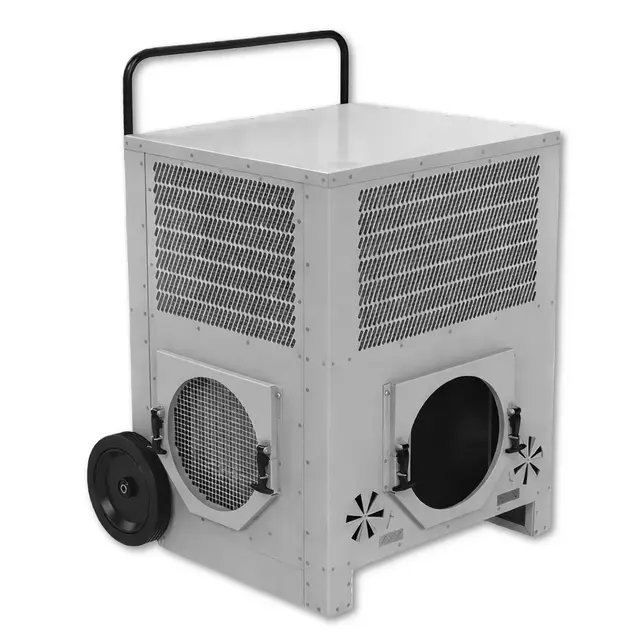
Mobile air-conditioner
6 kW rugged mobile air conditioner for temporary ducted cooling in commercial and industrial environments.
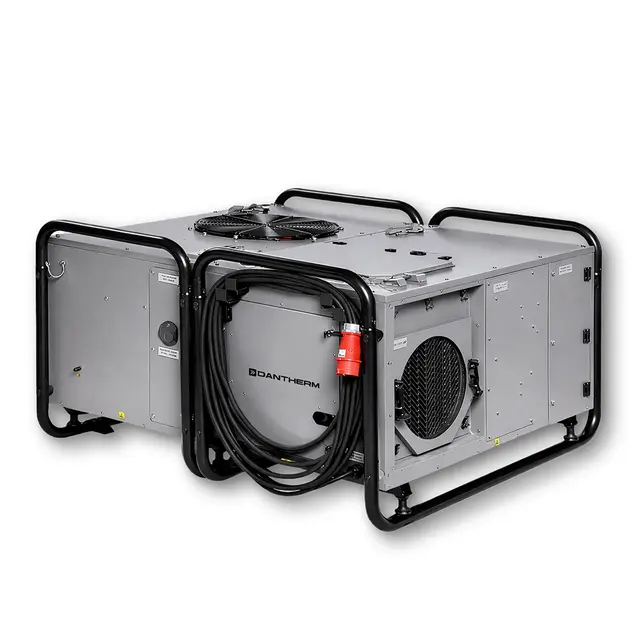
Mobile air-conditioner
11 kW rugged mobile air conditioner for high-capacity temporary cooling with ducted air distribution.
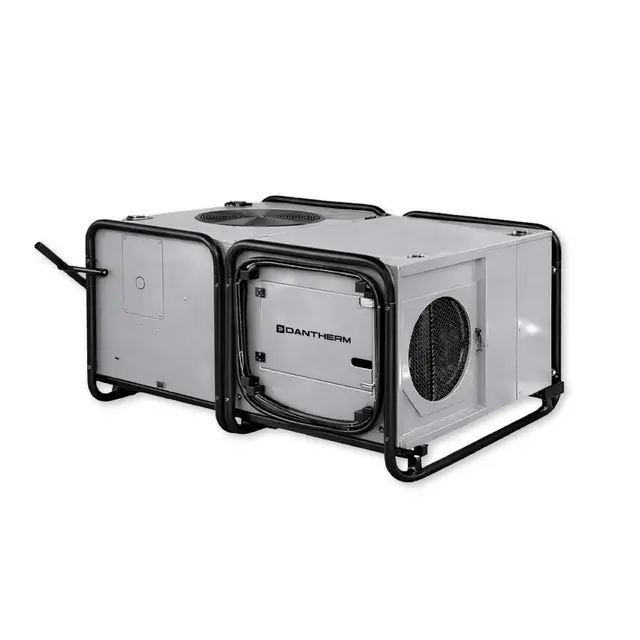
Mobile air-conditioner
18 kW rugged mobile air conditioner for large-scale temporary ducted cooling applications.
Need help with choosing the right solution? Our team of over 100 climate control experts can assist.
You can also reach out or join the discussion on our Social Media. Check out our LinkedIn page.